
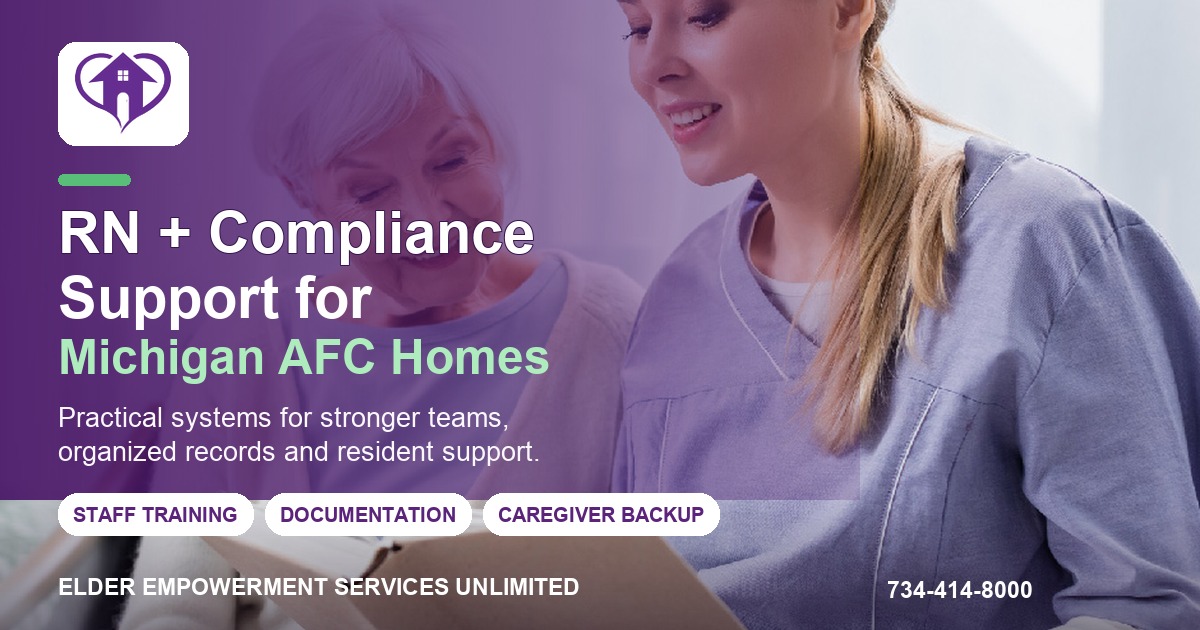
Running an adult foster care home means doing many jobs at once. You are supporting residents, supervising caregivers, communicating with families and providers, filling staffing gaps, organizing records and staying ready for licensing questions. Even experienced AFC owners can reach a point where another set of trained eyes would help.
That is where an AFC RN and compliance-support service can add value. The goal is not to take over the home or replace the licensee. It is to help the owner build repeatable systems, train staff, recognize clinical concerns and close documentation gaps before they become larger problems.
Quick takeaway
Practical RN and compliance support can help AFC owners create a regular documentation rhythm, strengthen staff training, clarify medication workflows, coordinate resident care and build a safer backup plan—while the licensee and administrator retain full responsibility for the home.
Michigan’s current AFC rules make the licensee responsible for compliance and require facilities to maintain extensive resident, staff, incident, emergency and operational records. The rules also require direct care staff to receive training and demonstrate competence before independently performing assigned tasks. A structured support partner can help an owner organize those responsibilities into a workable monthly routine. [1]
1. Turn compliance readiness into a routine—not a crisis
AFC compliance is easier to manage when records are reviewed throughout the year instead of gathered only before a renewal, inspection or corrective-action deadline. A focused readiness review may include resident records, care agreements, assessment plans, medication logs, physician orders, incident reports, employee files, training records and open action items.
Michigan Rule R 400.617 lists many records a licensee must maintain, including resident records, the resident register, care agreements, accident and incident reports, staff records, personnel policies, fire-drill records and the emergency-preparedness plan. [1] A monthly spot-check process can help the owner see what is complete, what needs follow-up and who is responsible for closing each item.
2. Give caregivers clearer onboarding and ongoing training
New caregivers need more than a quick tour of the home. They need clear expectations about resident rights, reporting, first aid and CPR, personal care, supervision, fire safety, communicable-disease prevention, food safety, nutrition and resident-specific duties.
Michigan Rule R 400.629 requires direct care staff to be trained and competent in specified areas before performing assigned tasks independently, and it requires training documentation to be maintained in the staff record. [1] An RN-led onboarding or in-service program can help the owner connect required topics to the actual work caregivers perform in that home.
3. Strengthen medication processes and role clarity
Medication problems often begin with unclear roles, outdated orders, incomplete logs or inconsistent follow-up. An RN can help review the medication workflow, compare medication lists with current orders, reinforce documentation expectations and identify questions that should be taken back to the prescriber or pharmacist.
Michigan Rule R 400.675 addresses resident medications. It requires medications to be given as prescribed or directed, requires staff who supervise medication-taking to be trained in proper handling and administration, and requires an individual medication log with specific information. The rule also addresses refusals, medication errors, as-needed medications and instructions from licensed health professionals. [1]
This does not mean every medication task becomes an RN task. It means the home can have clearer boundaries between caregiver responsibilities, RN review and services that require an order or additional clinical acceptance.
4. Recognize resident changes earlier and respond more confidently
A caregiver may be the first person to notice that a resident is eating less, becoming weaker, developing new confusion, falling more often, refusing medications or showing a change in skin condition. The next question is what to document, who to notify and whether an RN or medical provider should assess the resident.
An RN support relationship gives the owner a clinical resource for assessment, care-plan questions, medication concerns, family education and provider communication. When ordered care is appropriate and accepted, private-duty nursing may also support services such as wound care or other selected treatments. Clinical services remain subject to assessment, availability and appropriate provider orders.
5. Improve communication after hospital or rehabilitation discharge
The first days after a hospital or rehabilitation discharge can create risk and confusion. Medication lists may have changed. Follow-up appointments may be pending. New equipment, diet instructions or wound-care orders may need to be understood. Caregivers and family members may each have only part of the information.
An RN can help organize the discharge paperwork, reconcile questions for the treating provider, update the care team and identify what caregivers need to know for daily support. This creates a more coordinated handoff while preserving the roles of the resident’s medical providers and the AFC administrator.
6. Build a safer staffing backup plan
A call-off can quickly become an operational problem when the replacement caregiver does not know the residents, medication routines, transfer needs or emergency procedures. Staffing support is most useful when the owner has already identified the skills and orientation needed for each shift.
Michigan Rule R 400.633 requires sufficient direct care staff to provide supervision, personal care and protection and to deliver services in the resident’s assessment plan, health care appraisal and care agreement. The rule also explains that private-duty staff cannot automatically be counted toward the direct-care ratio unless the individual meets direct-care qualifications and is providing direct care on behalf of the licensee. [1]
A supplemental-caregiver service can help with call-offs, vacations, respite or short-term pressure, but coverage still depends on staff availability, resident needs, orientation and a mutually agreed scope.
7. Give owners practical support for growth and start-up
A new AFC home needs usable systems before the first resident moves in. Admission paperwork, employee files, training schedules, medication documentation, emergency records, policies and monthly review routines should work together—not live in separate binders that no one understands.
Established owners also benefit when they add a second home, take on a higher-acuity resident or redesign responsibilities among managers and caregivers. A practical consultant can help translate requirements into checklists, workflows and accountability without promising licensure approval or a particular inspection result.
What an AFC support service does—and does not do
A useful AFC support relationship should be clear about boundaries.
- The AFC licensee and administrator remain responsible for facility operations, staffing decisions and regulatory compliance.
- A readiness review is consultative. It is not legal advice and does not guarantee an inspection result, license approval or the absence of citations.
- Private-duty RN services require assessment, clinical acceptance, nurse availability and appropriate provider orders when applicable.
- Supplemental caregiver coverage depends on staffing availability, resident needs, required competencies and care fit.
- Insurance, Medicaid, VA or other benefit coverage should never be assumed; eligibility and authorization must be verified separately.
How Elder Empowerment’s AFC Support Program can help
Elder Empowerment Services Unlimited LLC offers practical AFC-owner support in Wayne, Oakland and Washtenaw counties. Services can be used for a one-time project or as an ongoing support relationship.
Current service rates: Private-duty RN support is $150 per hour with no minimum-hour requirement. Caregiver support is generally $28–$35 per hour depending on visit length. Training, documentation and compliance-support projects are quoted after the scope is reviewed.
A simple first step
Start with one problem—not the entire home. Choose the area creating the most pressure: medication documentation, staff onboarding, employee files, hospital-discharge follow-up, caregiver coverage or an upcoming readiness review. A focused first project can show what is working, what needs attention and whether ongoing support would be valuable.
Talk with an RN and AFC owner
Discuss RN support, caregiver backup or compliance-readiness assistance in Wayne, Oakland or Washtenaw County.
Frequently asked questions
Does an RN consultant replace the AFC administrator?
No. The licensee and administrator keep responsibility for the home’s operations, staff and compliance. The consultant provides review, education, organization and clinical support within the agreed scope.
Can the service help prepare for a licensing inspection?
It can help organize records, identify gaps and track corrective actions. It cannot guarantee the outcome of an inspection or prevent every citation.
Can Elder Empowerment provide direct resident nursing care?
Potentially. Private-duty RN services may include assessment, medication review, provider communication, care coordination and accepted ordered nursing services. Every request is reviewed for clinical fit, availability and required orders.
Can caregivers be supplied for call-offs or temporary coverage?
Supplemental caregiver support may be available for short- or longer-term needs. Coverage is not guaranteed and depends on schedule, required competencies, resident needs and the agreed assignment.
Where is the service available?
Elder Empowerment focuses on Wayne, Oakland and Washtenaw counties in Southeast Michigan.
Sources and regulatory references
- Michigan Department of Licensing and Regulatory Affairs, Licensing Adult Foster Care Facilities, current administrative rules, including R 400.603, R 400.617, R 400.629, R 400.633 and R 400.675.
- Michigan Legislature, Adult Foster Care Facility Licensing Act, 1979 PA 218.
- Michigan LARA, Adult Foster Care licensing and provider resources.
This article is educational and is not legal advice. Requirements and individual service needs should be confirmed with the applicable licensing agency and licensed professionals.
Leave A Comment