
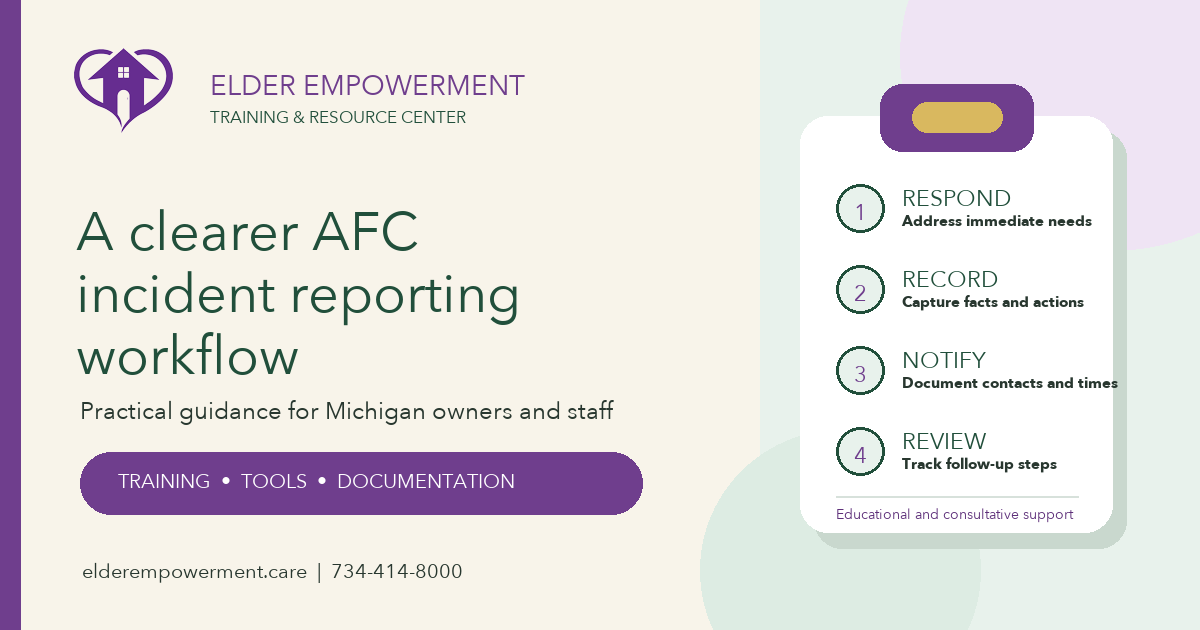
Michigan AFC Incident Reporting: A Practical Documentation Workflow for Owners and Staff
An incident can turn a normal shift into a rush of phone calls, care decisions and questions. Once the immediate situation is stable, staff still need to record what happened, who was notified and what follow-up is needed. That process is much easier when the home has one clear workflow before an incident occurs.
The current Michigan AFC rules define an incident as an intentional or unintentional event in which a resident experiences physical or emotional harm, dies unexpectedly or unnaturally, is displaced by a natural disaster, or elopes. The consolidated rules effective November 3, 2025 apply the general incident rules to Michigan AFC facilities.[1]
A useful Michigan AFC incident reporting process should help staff act quickly without guessing.
Respond to the resident before reaching for the form
The first task is the resident’s immediate safety and care. Staff should follow the home’s emergency procedures, obtain needed medical help and contact the person responsible for on-shift supervision. The report comes after the urgent response is underway.
Staff should preserve basic facts while they are fresh: the date, time, location, people present, what was observed and what action was taken. They should avoid delaying care so a form can be completed or a supervisor can be reached.
Elopement has a specific response in the current rule. Staff must begin an immediate search. If the resident is not located within 30 minutes after the search begins, staff must contact law enforcement.[1] A facility procedure should identify who starts the search, who checks each area, who tracks the time and who makes the call.
Know what Rule 693 requires
When a resident has a representative identified in writing on the care agreement, Rule 693 requires the licensee to report to that representative within 48 hours after any of these events:
- An unexpected or unnatural death
- An unexpected and preventable inpatient hospital admission
- Physical hostility, self-inflicted harm or harm to others that causes an injury requiring outside medical attention or law-enforcement involvement
- A natural disaster or fire that causes resident evacuation or a service interruption longer than 24 hours
- Elopement when the resident’s location is unknown
These categories should appear in staff training and the facility’s notification checklist. A general instruction such as “tell the manager if something happens” leaves too much room for delay.
The rule also says the incident must be recorded on a department-approved form or a facility form containing the same information, then retained at the facility for two years.[1] If the department requests the report, the licensee must provide it electronically within 24 hours after the request.[1][2]
Other laws, contracts, responsible agencies or facility policies may require separate reports or different timelines. The licensee should compare the event with every requirement that applies instead of assuming one incident form completes every duty.
Use one Michigan AFC incident reporting workflow
A simple workflow can keep the process moving even when the owner is not onsite:
- Protect the resident and address urgent care needs.
- Notify the on-duty supervisor or administrator through the facility’s chain of command.
- Record the facts as soon as practical.
- Check the notification list and document the date, time, method and person reached.
- Have the licensee, designee or administrator review the report for missing information.
- Identify follow-up, corrective measures, care-plan questions or staff coaching.
- File the completed report securely and add any due dates to a follow-up tracker.
The workflow should name a backup reviewer for nights, weekends and vacations.
Capture the details another reviewer will need
Michigan’s current incident form asks for facility and license information, the person directly involved, witnesses, the date and time, the location, what happened, any injury, staff action or treatment, corrective measures, medical care, notifications and signatures.[7] LARA also provides an online version with the same practical sections.[6]
A strong report separates three types of information:
- Observed facts: what staff saw, heard or found
- Actions: what staff did, who was contacted and when
- Follow-up: what still needs review, monitoring, training or correction
Write names, dates and times clearly. Identify the source when information came from someone else. If a diagnosis is not known, do not guess. If the report continues on another page, label and secure the attachment with the same incident record.
Write facts, not blame
Incident reports should be specific and neutral. “Resident found seated on the floor beside the bed at 7:10 a.m.” is more useful than “resident fell because staff were careless.”
Avoid copying the same vague phrase into every field. “Supervisor notified” is incomplete without the supervisor’s name, time, method and response. “Continue to monitor” should explain what will be monitored, by whom and when the next review will occur.
Corrective measures deserve the same care. A useful entry might document a revised check schedule, equipment review, care-plan meeting, staff coaching or request for clinical evaluation. The chosen step should match the facts and the responsible professional’s role. An incident form should never be used to alter an order or make a clinical decision outside the writer’s authority.
Train staff before the next incident
Michigan’s current rules require direct care staff to be trained and competent in reporting requirements before performing assigned tasks independently, and the training must be documented in the staff record.[1]
A short in-service can use a sample event with no resident information. Ask staff to decide what requires immediate action, which facts belong in the report, who must be notified and what should be escalated. Then compare the exercise with the home’s policy and current official form.
Supervisors can also review a small sample of closed reports for legibility, complete notification details, signatures and documented follow-up. The goal is to spot a weak process early, not to wait for an inspection or complaint.
Keep separate reporting duties visible
An AFC incident report does not replace a report of suspected abuse, neglect or exploitation. Michigan MDHHS says certain professionals, including physicians, nurses, aides and others in health or human services, may have a legal duty to report suspected harm or risk of harm to a vulnerable adult. The state’s reporting number is 1-855-444-3911.[5]
Staff orientation should explain when to use emergency services, Adult Protective Services, law enforcement, the Office of Recipient Rights, a responsible agency, a designated representative or another required contact. Owners should confirm the exact routes that apply to their home, population and contracts.
How Elder Empowerment can help
Elder Empowerment’s Training & Resource Center can help Michigan AFC owners organize an incident-reporting workflow, staff in-service, supervisor checklist or documentation review. Support is educational and consultative. The licensee or administrator remains responsible for facility operations, current requirements, staff competency and regulatory compliance. No inspection or compliance result is guaranteed.
Training and documentation support is separate from Elder’s caregiver and private-duty RN services. Caregiver services do not become nursing services, and private-duty RN work depends on assessment, availability, clinical acceptance, competency and appropriate orders when required.
Visit the Training & Resource Center: https://elderempowerment.care/training-resources-michigan-senior-care-providers/
Call Elder Empowerment Services at 734-414-8000 to ask about incident-reporting training, documentation tools, or a compliance-readiness review for your Michigan AFC home.
Frequently asked questions
Does every incident have to be sent immediately to LARA?
Do not use one blanket timeline for every event. Under Rule 693, the incident report is retained at the facility, and the department may review it during a renewal inspection or special investigation. If the department requests the report, the licensee must provide it electronically within 24 hours. Other rules, agencies, contracts or circumstances may create separate reporting duties.[1][2]
Can an AFC home use its own incident form?
The current consolidated rule allows a department-approved form or a facility form that contains the same information. Compare any custom form with the current official form and current rules before use.[1][7]
How long should an incident report be kept?
Rule 693 requires the report to be retained in the facility for two years.[1]
Can staff wait for the owner before responding?
No workflow should delay urgent care or emergency action. Staff should know the facility’s chain of command, their immediate responsibilities and the backup contact when the owner or administrator is unavailable.
Official Michigan resources
- Michigan Adult Foster Care Facilities Rules (effective November 3, 2025)
- Michigan LARA — AFC Licensing Division Incident/Accident Report
- Michigan MDHHS — Mandated Reporters
- Michigan LARA — AFC Online Incident/Accident Report Form
- Michigan AFC Licensing Division Incident/Accident Report (BCHS-4607, Rev. 11-25)
Educational and consultative information only. Current Michigan rules, payer requirements, professional judgment and facility-specific policies control. The licensee or administrator remains responsible for operations, staff competency and regulatory compliance. No inspection or compliance result is guaranteed.
Leave A Comment